



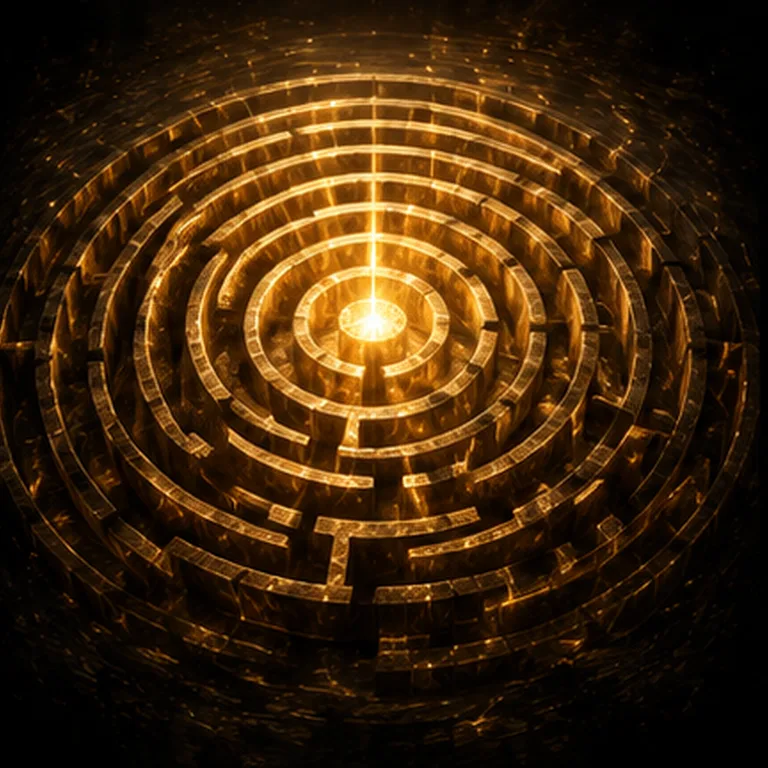








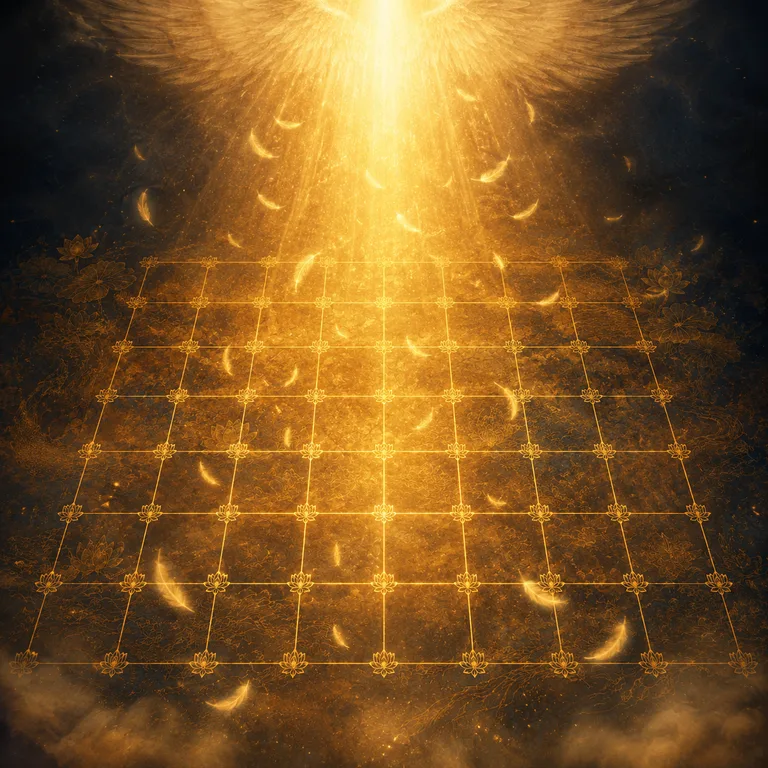













































The Game of Lila - also written Leela or the Game of Self-Knowledge - is one of the oldest contemplative tools in human history. It originated in ancient India, most scholars place it somewhere in the first millennium CE, as a diagram of the soul's journey through consciousness. The version that spread across the Indian subcontinent wasn't designed as entertainment. It was a map: the board showed the inner landscape of a human life, and the dice were the mechanism through which something larger than personal preference placed the player exactly where their soul needed to be.
Most people first encounter the game through the Western descendant - the children's board game with snakes and ladders. Strip away the competitive scoring and what remains is the original spiritual structure: 72 stations, some of which lift you forward, some of which bring you back, none of which you choose for yourself.
The 72 cells cover the full range of inner experience. They begin at Birth - pure potential, no karma yet accumulated - and end at Cosmic Consciousness at the summit of the board. In between, the board moves through every quality a human soul encounters on the path: shadow states like Anger, Greed, Jealousy, Pride, Attachment, and Ego; turning points like Forgiveness, Devotion, and Surrender; higher planes like the Solar World, the Lunar World, the Celestial Realm; and advanced stations like Liberation, Unity, and Bliss Gate. No cell is there by accident. Each one was placed in its position by practitioners who had mapped the terrain from the inside.
The snakes in the Lila game are not punishments. They are descriptions of how karma actually moves. Pride (cell 12) returns you to Jealousy (cell 8) because unexamined pride and unprocessed jealousy are the same unresolved material - one is the inflation, the other is the wound underneath. Arrogance (cell 24) drops you back to Fear (cell 7) because superiority is a performance built on top of the fear of being inadequate. Ego Reassertion (cell 63) sends you all the way back to Illusion (cell 2) because the last bid of the old self is always to make the seeker believe they're still at the beginning. The fall is not failure. It is information.
The ladders are equally precise. Right Action (cell 10) lifts you to Wisdom Land (cell 23) because conscious deeds done from genuine values build the architecture through which wisdom becomes accessible. Grace (cell 17) carries you directly to True Reality (cell 69) because grace is, by definition, the movement that exceeds what effort can earn. Compassion (cell 22) elevates to the Celestial Realm (cell 60) because genuine compassion - not performed compassion but the kind that arises from actually seeing yourself in another person - opens a quality of perception that ordinary self-centered consciousness can't reach.
The game is played with a single die. You bring one question, or you bring nothing, and you roll. The cell you land on is the teaching for right now. Not the teaching you would have chosen, not the one that seems most relevant to what you think your problem is - the one you got. Working with what you actually received, rather than what you would have preferred, is the first and most important practice the game teaches.
In this version of the Lila game, each cell you land on provides three layers of reading. The first describes the essence of the station - what this quality or experience is about at its deepest level. The second contextualizes your landing: what does arriving here mean on your path at this moment, what is being asked of you, what is present. The third offers a concrete practical step - something small enough to do today that carries the energy of the teaching into your actual life.
The Lila game has been used for personal reflection, for group spiritual practice, for divination, and for therapeutic inner work. Whatever brings you to the board, the board will meet you honestly.